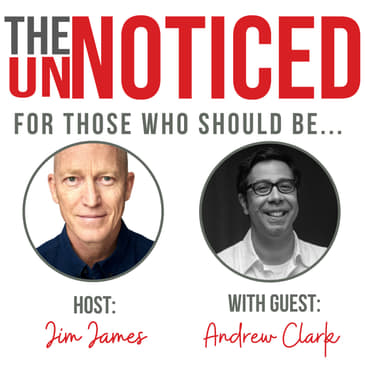
In this episode, I have the pleasure to interview Andrew Clark, a partner in Asia Works and former journalist at the BBC and CNN who now makes award-winning videos for clients including Rolls Royce and Unicef from their offices in in Singapore, Jakarta, Bangkok and Beijing. We met on a plane ride in 1997 from Singapore to Phuket - he had so much kit with him it started a conversation and a life long friendship.
We discuss how his clients are using video for their public relations and education programs, the impact of handheld camera clips, if we should be using a green screen when we make our own videos, and some professional accessories any budding producer should have.
Remember that video can be very powerful, but doesn't have to cost a lot.
Some case studies which worked:
JetBlue came up with a video idea to make such a baby-crying flight a win-win for everyone involved. JetBlue’s promotion of the video on their Facebook page has garnered over 1.3 millions, and it’s been seen over 1.6 million times on YouTube
I mention our work with AsiaWorks for Brompton Bicycles. The Overnight Brompton 100KM Ride around Singapore, on 20 January 2018, is a community event held by local owners with the support of the local retail agent. The Brompton UK company contracted EASTWEST Public Relations to make a video of the event and to share that on social channels including our own and the local clubs promoted the video via their social channels including Facebook and Twitter. See the Ride video here
Video can be low cost, self-made, and impactful for PR; but Andy's key advice - be authentic, keep it simple, and have fun.
Read the article version of this episode - https://theunnoticed.cc/episode/learn-how-rolls-royce-are-driving-their-pr-with-video-in-asia-should-you-film-with-a-green-screen-and-how-to-not-make-boring-videos
If you like this podcast, then subscribe to our newsletter here
Please visit our blog post on PR for business please visit our site:
https://www.eastwestpr.com/blogs/
I also talk about SPEAK|pr - our 5 Step Methodology for entrepreneurs to manage their own PR. Do please come and download a free copy along with our Technology Applications Director with over 100 free marketing apps listed.
http://www.eastwestpr.com/speakpr
Find us on Twitter @eastwestpr
Jim James is the Founder and Managing Director of the EASTWEST Pu
If you want to know how to get noticed this show is for you. I have interviews, tools, tips, everything that an entrepreneur could need in order to help their organization to get noticed for free. Thank you for joining me on the unnoticed show.
Buzzsprout - Let's get your podcast launched!
Start for FREE
Please rate the show here.
Thank you for listening to this episode of the unnoticed to show. I hope that you've enjoyed. If you have, please do rate it on any of the players. If you'd like more information, go over to EASTWEST PR and subscribe to our weekly newsletter. Or connect with me on Linkedin that's just Jim James. I'd be delighted to connect with you and let me know how i can help you to get noticed.
Support the show (https://lovethepodcast.com/Unnoticed)
The UnNoticed Entrepreneur is hosted & produced by Jim James.
Today, I'd like to talk about the power of corporate video (should you make selfie videos and post them on LinkedIn) and the tech gadget that we should all have. I interviewed Andrew Clark, who is the partner of AsiaWorks and who's based in Singapore. Andrew and I met over 20 years ago on a plane flying from Singapore to Phuket. He was that passenger with so much luggage that you hoped you wouldn't sit next to on the plane, but lo and behold, he was seated next to me on the plane. He took up all of the storage room in the overhead lockers with his kit. We got chatting, and it turned out that he was a TV anchor and producer. At the time, had been working for BBC, and he has worked for the CNN as well. He has since been working for AsiaWorks for the last nine years, which is a video production company with offices in Singapore, Jakarta, Bangkok, and Beijing. Later on, he and I got the chance to work together on the Brompton Bicycle Race in Singapore, which turned out to be very successful. First off, I asked Andy what it is that makes kids so attracted to videos that they stop whatever they're doing, and in his opinion, he believes that it's primal. The colors, the sound, the pictures, the moving images all catch our attention. The next thing I wanted to ask Andy was to give some examples of low- to mid-budget videos that he's made (as an award-winning video producer) for his clients to help bring in PR results. He had three examples, because he believes it's important to put into perspective the types of videos that you can create, since there's so much you can do in the video space. The first example, he says, is a series of videos that he made for Rolls Royce. Rolls Royce in Asia is in a position where they're in the business of changing the perception that Rolls Royce is a car for slightly older gentlemen into a car that is more universal, younger, and attractive to an Asian audience. Over the last few years, he's been working on a campaign with Rolls Royce to make first person stories and customer testimonials from Rolls Royce owners around the Asia-Pacific region. They've filmed in Hong Kong, New Zealand, and Australia, and they've shared first person-told stories about Rolls Royce owners. This happened to bring results for Rolls Royce and ones they are very proud of. The second example, Andy said, would be medium budget. He worked with UNICEF to produce a whole load of different types of content. Recently, in Jakarta, they've been making videos during the COVID period for best practices in the areas of hygiene and communicating some of the important messages that UNICEF have during this period. Again, that's something where results have come from it. But more importantly, he thinks it's something that, "we, as a company, and they, as a client, can be very proud of." The third example is a project that Andy did with a friend of his last year. His name is Irfan Tayabali, and he is an entrepreneur. Last year, Andy helped him make some videos for a purpose planner, which is a written six-month planner that Irfan developed and sells online. They made a series of videos to help promote his planner on his website and on social media, and that's turned out well for him. Andrew's examples were great. They were entirely different and entirely worthy video production roles. I then went on to ask him for tips he could offer small entrepreneur-led companies or SMEs that want to make their own videos. He begins by saying that the assumption around making videos is to keep it short, around eight seconds or so, because that's supposedly how long people's attention is on social media. Now, while that might be true, he believes that, at the end of the day, once you've won someone's attention, which is really what the key thing is here, then your video can basically be as long as you want. His advice before he gets into the three top tips, above all of the top tips, is not to be boring. How can you not be boring? He says you need to find someone that you really trust, someone who knows you well, and show them the video. They'll tell you if it's boring. Here are the three top tips according to Andy. Number one: the old KISS strategy, Keep It Simple, Stupid. Simple messaging. Keep it to two or three messages in your video. Anymore, you're overloading the viewer, especially if you're in a sales or product or customer testimonial situation where you need about two or three messages. Second thing, he says, is to be authentic and polite. Don't go out to interrupt your viewer. Don't use those sales-y style scripts or TV advert-style script lines to capture attention. Those are old school. People don't like that. They don't see it as authentic. They know they're being sold to. They can immediately tell that what you're doing is inauthentic, so be polite, and be real. Tell real stories and feature real people. Finally, end with a call to action. Make it compelling, and ensure there's a specific action the viewer needs to take after they watch your video. So, number one, KISS, Keep it simple, stupid. Number two, be authentic, be polite. And number three, end with a call to action. That's it. When it comes to filming, whether we can film at home or anywhere, or if we could make use of green screens, first of all, apparently, he "hates" green screens. He was disappointed that I even contemplated that. He says to go back to point number two in the three top tips, which is to be authentic. People obsess too much about using green screens. One thing which has come out of what's been going on with COVID is the buying of a Zoom subscription, a green screen, and a nice microphone off the internet. The green screen, then, becomes a portal for you to put extremely horrible backgrounds that don't look nice, that break apart, and that don't necessarily make you look any good as well, but in a kind of do-it-yourself way. Also, we can get a little bit over the top with green screens in terms of making them add things that aren't really there. So simply put, from an authenticity point of view, for being authentic, he would not advise to use a green screen. He would advise always to work on trying to make a nice shot in a place that's real. That means simply getting onto YouTube and finding out what things like good framing are, decent lighting, stuff that you can do even with a webcam. He says to just get online, get onto YouTube, and find out what it is to film a nice-looking image. Apparently, I'm guilty as charged on all fronts, I'm afraid, as I myself have got a mic, a Zoom subscription, and a web camera. I then asked about what Andy thinks is the impact of the handheld, earnest, into-the-camera speaking videos on LinkedIn or Facebook wherein people talk about "Today's top tip" or "Thought for the day," and so on. His opinion about this really comes down to who you are. The first thing is that there's too many of these types of videos. There was a period last year where everybody seemed to be doing them, and he still sees a lot of them on sites like LinkedIn. He thinks that people are a little bored of them. When it comes down to who you are, it's really about how well you can present and how concisely you can present. If you're not good at getting it down right the first time, Andy says you need to practice, and you need to ensure that your messaging is really tight (remember: KISS!). And in these and with these type of videos, he would also advise to try and keep them short. Follow the three top tips: two to three messages, Keep It Simple, Stupid, be authentic, be polite, and then end with a call to action. Follow those rules. But overall, he would say that there's a bit too many of these types of videos out there at the moment, and people are a little bit tired of them. Assuming that someone has got the budget and realizes really the value of engaging professionals to help them, according to Andy, the good news is there are so many places you can go to outsource your video making. That's one way to go about it. The bad news is, because there are so many ways and people and websites and solutions out there, it's very hard to get a gauge of even things like market rates for doing things like a shoot or an edit. The simple fact is that if you want to find somebody to shoot something for free for you, you could probably find it. If you want to find someone to put a whole video together for free for you, or for very little cost, you could probably do that as well. He says the best way to outsource videomaking is, really, to find people like yourself, find out who they're using, and to really check any potential partner that you're going to work with and crucially check the past work that they've done, because it's very easy these days to put up a website with a video on it and say, "I made this." But when you scratch beneath the surface, you might find that they've only done a very small component of that video that they're saying that they made. He reminds us to be very careful in terms of choosing someone to help you make a video. You should check through your network to find somebody, check their references, and check their work very closely. On a final note, he added that if you're looking for services like animation or editing, then websites like Fiverr can be very useful, but again, you want to check those freelancers' credentials, and you want to check the work that they've done previously. Finally, when it comes to videomaking, I asked Andy if he knows of any cool technology that he thinks we should all have, buy, borrow, or steal. For him, having a smartphone with a good camera is definitely a must-have. He wouldn't advise going out and buying a nice camera to film videos from the outset. He says to practice first on your own camera. A lot of the peripheral stuff is overlooked in terms of buying equipment when you want to start making your own videos. Investing in something like a good tripod, he thinks, is really important, and so is investing in a good microphone system that either works with your phone or with your computer. You could get a USB microphone perhaps, those things are really important. Both Andy and I have Rode-NT USB mics, and they're excellent. If you're going out to make a video and you don't have any kit, Andy says to have a look into renting a kit. There's plenty of places online that you can rent camera equipment from, or there will be a local rental house near you that has a really cool kit that you can rent. I actually sold my digital Sony when I saw the quality that my daughter's iPhone 11 had, and I found that the interface on the screen and the peripherals were so much easier to carry around, and the quality of the 4K video now on the iPhone is fantastic. But like Andy, I felt that ther really can't be a compromise o the microphone, the steadying o the shot with the tripod, and a so the ring lights, which is o e item that he didn't me tion, but it is great to have s it creates an even coloring for indoor photogra hy, which is really key, but obv ously, I'm very grateful to Andrew for sharing his insights. The work he's done with Rolls Royce, UNICEF, and even the one with Irfan Tayabali on personal branding shows us that video can play a key role, and also that video doesn't have to cost as much as it used to. There are people out there on platforms like Fiverr and Upwork, for example, that can bring certain skill sets, and remember, even the big movies are made with, basically, a consortium of individuals who have come together for a project. Nowadays, equipment can be rented, so we don't even have to buy lots of fixed cost equipment. Video can and should play a key role, and I found, in managing to use the new Zoom update, that I can livestream video to my Facebook from the Zoom call, and I can save the video file afterwards. Video production, both outdoors and indoors, online and offline, is becoming so accessible to business owners, and it really is becoming as easy as holding your handphone. But as Andrew said, and thank you for that, Andrew, being authentic is really what people are looking for, and letting people know what's real with you is going to be a key to being successful. Ultimately, that's great, because being authentic doesn't cost anything at all. It just takes some forethought and some planning. With that, I'd like to thank Andrew Clark, the partner of AsiaWorks, a longtime friend, a video guru, a mind of information, and a delight to work with, for joining me.